
EU enlargement is gaining renewed attention, and so is public opinion on the issue. EU-wide, a majority of citizens are in favour. Yet recent Eurobarometer data show that the enlargement question draws more “don’t know” responses than other EU policies and closely tracks broader EU sentiment. Adjusting for EU evaluation narrows down the demographic and ideological divides. These patterns are more consistent with a thermometer reading than a mandate.
After years of relative stagnation, the prospect of European Union (EU) enlargement has picked up new steam. Russia’s war against Ukraine has given renewed urgency to the questions of when and under what conditions the EU should enlarge, returning enlargement to the centre of the EU’s political agenda. This renewed momentum was especially visible in the recent accession conferences held with Ukraine, Albania, Moldova, and Montenegro in July 2026. As enlargement becomes a more immediate prospect, public opinion in existing Member States is becoming increasingly relevant.
In this context, public opinion is routinely, if selectively, invoked through topline poll findings (e.g., aggregate population mean estimates) or demographic breakdowns by media outlets, parties, and governments to lend democratic legitimacy to competing positions on enlargement. Given the geopolitical, political-economic, and symbolic ramifications of admitting new members, taking citizens’ views seriously is essential to keep the European project democratically accountable, and to avoid fuelling contestation and polarisation around European integration. Yet, public discussion on citizens’ attitudes towards enlargement remains cursory, often lingering on the percentage of survey respondents who report being “for” or “against” further expansion. Survey research has long shown, however, that not all expressed opinions are equally meaningful or equally informed. When asked about a weakly salient or unfamiliar issue, citizens frequently employ informational cues and heuristics or draw on broader orientations to provide an answer. In the case of enlargement, a response may therefore reflect not only a position about the prospect of admitting new states, but also a broader sentiment to a simpler question: how much do I like the EU?
This brief asks how much apparent public support for enlargement is actually about enlargement itself. Based on an original analysis of recent Eurobarometer data, the next section shows that attitudes towards enlargement are strongly anchored in broader EU evaluations. Several demographic and political divides narrow considerably once EU orientations are accounted for. The closing section considers what over-extrapolating from topline poll numbers may imply for the politics of enlargement.
What do the polls tell us?
A useful starting point is Philip Converse’s early recognition that citizens can readily provide an answer to a survey question, even when they might not possess a firm opinion on the issue they are being asked about. The implication is not that such answers are meaningless or invalid, but that they are less crystallised than poll numbers may make them appear. EU enlargement, being a distant foreign policy issue, might be especially susceptible to drawing such non-crystallised opinions.
To explore this question, this brief draws on data from the Spring 2025 Eurobarometer, fielded between 26 March and 22 April 2025 across 27 EU Member States. This survey is particularly well suited to the question at hand, because of the Eurobarometer’s scope. Apart from enlargement, respondents are asked whether they favour or oppose an extended set of EU policies, allowing for more context on the patterns of responses collected by the enlargement question.

Figure 1: Aggregate support for EU enlargement in the pooled EU27 sample. Estimates use population-size-adjusted survey weights incorporating national post-stratification weights. Author’s elaboration.
Looking at the data in Figure 1, enlargement enjoys a clear majority, with just over half of EU citizens, 54.2%, being in favour, compared to 38.5% opposing it. On the surface, this figure can be read to carry a clear mandate in favour of enlargement. Even by accounting for respondents who chose to not express a position on this question, support remains majoritarian. Yet, the amount of stated no opinion itself can be instructive, especially when juxtaposed to neighbouring questions of similar interest.
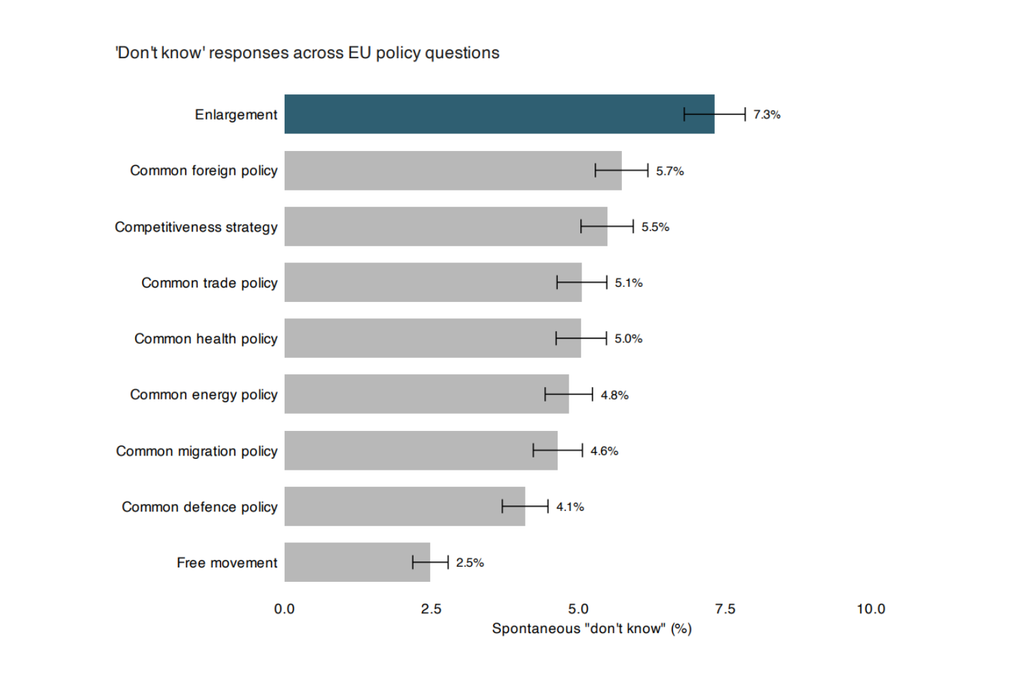
Figure 2: Aggregate share of “don’t know” responses on EU policy questions in the pooled EU27 sample. Estimates use population-size-adjusted survey weights incorporating national post-stratification weights. Author’s elaboration.
There is reason to suspect that enlargement attitudes are less crystallised than a headline number may suggest. Consider Figure 2, demonstrating the share of “don’t know” responses across a set of EU-level policy questions. Around 7% of respondents gave a “don’t know” response, markedly more than for any other EU policy asked alongside. The contrast is especially stark when enlargement is juxtaposed against free movement. This is perhaps unsurprising given the greater familiarity of free movement as a core feature of EU integration, but the pattern across all items is clear. For respondents, the question of enlargement generates markedly more uncertainty compared to other common policy considerations.
Therefore, the more interesting question is what anchors the opinions of those who did provide an answer. To address this question, we can look at how support for enlargement varies as a function of broader EU sentiment. As Figure 3 illustrates, enlargement support seems to be deeply rooted in citizens’ overall EU evaluation. Among respondents with a negative view of the Union, only 28% support enlargement. The same number jumps to 55% for those with a neutral view, and 74% among those respondents with a positive image of the EU. This gap in enlargement support, from 28% to 74%, shows how disagreement over enlargement rests on the more fundamental divide over EU image.

Figure 3: Aggregate support for enlargement, common defence, and free movement across respondents’ EU image levels based on the pooled EU27 sample. Estimates use population-size-adjusted survey weights incorporating national post-stratification weights. Author’s elaboration.
This pattern, of course, is not unique to enlargement. Support for a common defence mechanism and free movement of people follows the exact same motif of monotonic increase in step with EU evaluations. Crucially, however, the spread is larger in the case of enlargement and ranges between two poles of clear opposition to support. Compare this with the staircase pattern of common defence, or, even more illustrative, free movement, where support remains the majority across all bins of EU image.
Recognising that support for enlargement is anchored in broader EU sentiment has implications for how we read its constituency. At first glance, the familiar constituency divides are considerable. Younger and more highly educated respondents are, on average, more supportive of enlargement, while ideologically right-wing respondents are less supportive, compared to those on the left. Notice, however, how these apparent gaps narrow down once we adjust for respondents’ broader EU view in Figure 4.

Figure 4: Model-based contrasts in predicted enlargement support across age, education, and ideological groups before and after adjusting for respondents’ overall image of the EU, in the pooled EU27 sample. Estimates are population-size-weighted average contrasts, incorporating national post-stratification weights, with 95% confidence intervals. Author’s elaboration.
The shift is particularly sharp in the education divide. The gap between low and highly educated respondents in enlargement support contracts from nine percentage points to only three. Similarly, age and ideology gaps shrink by comparable, if slightly smaller, margins, leading to a picture of considerably more loosely structured constituency. In other words, these groups’ opinions over enlargement differ in large measure because of their differential views on the EU more generally.
The central insight for enlargement attitude is, therefore, that apparent cleavages around enlargement are overstated by topline poll figures. While the gaps do not collapse completely, their political relevance and interpretation get reframed in light of the central role of EU sentiment.
Closing remarks
Enlargement is back on the agenda, and so is attention to citizens’ opinions on it. Based on recent data, enlargement is supported by a majority of EU citizens. This support is not an artefact of topline data presentation. Yet, it elicits comparatively greater uncertainty among survey respondents, with a larger share reporting that they “don’t know”. Among those who do, support for enlargement seems to be structured by general EU sentiment, with seeming cleavages diminishing once the latter is accounted for. Taken together, these patterns are consistent with enlargement attitudes being comparatively weakly crystallised and strongly dependent on EU orientation.
For EU policymakers, this means that overinterpreting a favourable majority, or constituency differences, risks eliding the underlying uncertainty and weak crystallisation. At the same time, this uncertain type of support (or opposition) to enlargement is reminiscent of the ‘permissive consensus’ that characterised the EU integration process for decades. During that period, citizenries in Member States had weak attitudes and limited interest and knowledge of the EU. Yet, once the EU’s policy remit and visibility passed a certain threshold, and challenger parties started politicising the EU, citizens’ attitudes polarised accordingly.
If that episode of the integration process is any indication, enlargement could similarly enter a stage of politicisation and constraining dissensus. This dynamic is especially pronounced in the case of enlargement because of competing national interests and national sensitivities. This report focused on pooled EU27 data to provide an EU-level perspective. Yet, enlargement, broadly, enjoys varying levels of support among different Member States. This variation is likely to be more pronounced and polarised when it comes to evaluating enlargement on a more specific, country-by-country basis.
For these reasons, recognising the limits of topline public opinion numbers on enlargement is a necessary virtue ahead of the next big chapters of the European project. At present, they are more of a thermometer than a mandate.


