
Among the Central European countries, the Hungarian economic development is one of the most foreign capital directed. It is well known that the most significant investors are German companies, but in recent years an increasing number of Asian multinational companies have also appeared in Hungary. Investors receive large state support and enjoy low corporate taxes. However, problems of skilled labour are growing because of the neglected educational system.
Hungarian economic growth is one of the most based on foreign capital. In 2019, foreign-owned companies accounted for 53% of the sales and production of enterprises in the country, and in the manufacturing industry this ratio was 73%.[1] It is well known that the most significant investors are German companies, but in recent years an increasing number of Asian (South Korean) multinational companies have also appeared in Hungary.
Between 2012-16, however, Hungary was the most unpopular among the four Visegrád countries in the eyes of German investors, but from 2017 the trend has changed. In 2020-21, the popularity of all Visegrád countries grew anyway, which may also be due to production problems in Asia caused by the pandemic.
Results of a survey
The German-Hungarian Chamber of Commerce and Industry (DUIHK) published its latest economic survey report on May 31, 2022.[2] The percentage of German companies that would invest in Hungary again has continuously grown since 2015 and reached 88% in 2021 and 2022.
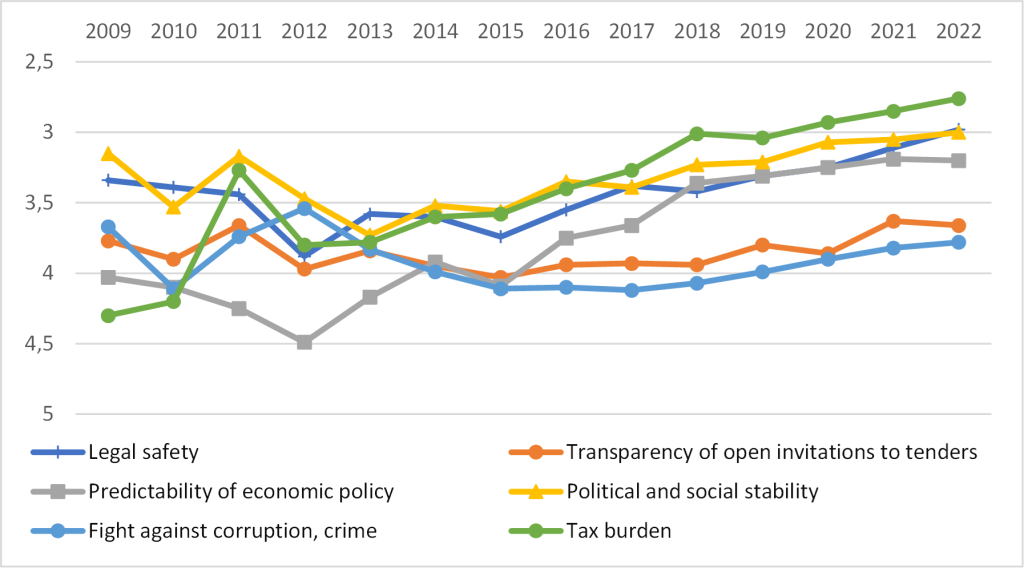
One should consider the factors with which German investors are satisfied, and those with which they are not, in terms of Hungarian economic policy. For this purpose, a survey including factors such as legal certainty, transparency, corruption, tax burden and predictability was conducted by DUIHK. Investors rate them on a 5-point scale, with 5 being the worst rating. In Hungary, since 2015 corruption and transparency of the public procurements received the worst rating, while other factors showed an improving trend in the eyes of German companies (Figure 1).
Figure 1: Evaluation of the economic policy framework in Hungary (1 = fully satisfied 5= fully dissatisfied)
Source: own compilation from the survey series of DUIHK
Tax burdens are mostly judged favourably, and infrastructure, predictability and the stability of economic policy are also considered positively by the German firms. In other words, German investors are satisfied with the fact that the Hungarian system is more or less predictable and the tax burden is low[3], despite high levels of corruption and opaque public procurement.
Several studies are presenting the institutionalisation of corruption in Hungary.[4] The companies close to the government that usually win the public procurements mainly displace other domestic companies, thus the larger foreign investors are not necessarily harmed. Since these domestic crony companies typically pay dividends to themselves[5] and do not return their profits to the economy, the country still needs foreign capital investments to function. The fact that German companies have well adapted to Orbán’s illiberal system is also shown, for example, by the fact that they carefully avoid advertising in non-governmental portals.[6]
Based on the chamber’s survey, there is another Hungarian factor which, since 2013, has been “favourable” to German companies well above the regional average (the region encompasses here 15 Central and Eastern European as well as Western Balkans countries): this is the “flexibility of labour law.” Not by chance, since the new Labour Code entered into force in January 2013, which favours employers over employees in many ways and reduces the bargaining power of trade unions.[7] It is known from previous investigative press articles that the managers of large German (mainly automotive) multinational companies have direct contact with the members of the government, or the prime minister.[8]
State support for multinationals
The importance of German car manufacturers is well known[9], as is the support provided to them (in the first decade of the Orbán government, Audi, for example, received four times as much support in Hungary as in Germany).
The list of “individual government decisions” on financial support has been public since 2004, and it reveals the name and nationality of the companies, the number of new jobs undertaken (which may later differ from those actually created), the amount of investment, and the amount of government support. In the period 2004-June 2022, 36.7% of the jobs created were at those 103 subsidised German companies that received 32.9% of the subsidies. A workplace at them costs HUF 8 million on average.
The support of Asian companies (a total of 52 Japanese, Korean or Chinese companies) is interesting: they are “more expensive”: they received 35.3% of the subsidies for foreigners for 20% of the foreign-created jobs, and one job here costs HUF 16 million (in comparison, Hungarians cost more than this: for the 67 Hungarian companies supported during the period, the subsidy per job was HUF 18 million).
60% of the state support provided to Asian companies was given to 11 battery manufacturing, or their supplying companies (10 from South Korea). One of them received state aid in 2018, the others in 2019-2022, reflecting the recent economic policy goal according to which the country will become a battery superpower.[10] There is quite a competition in the battery production within Europe as well: in Spain, for example, two or three huge factories will be established in the near future[11]; in Portugal, Europe’s largest lithium processing plant is built[12]; and in Poland, LG is also expanding one of the world’s largest battery factories.[13]
There is some contradiction between the emphasised importance of sustainability and environmental protection, and the environmental damages caused by the battery factories (e.g. endangerment of karst spring, symptoms of poisoning, noise, well pollution[14]) as well as their tolerance by the Hungarian authorities.
The Hungarian government supports export-oriented “good” foreign multinational companies with significant sums of money and with a favourable legal and tax environment, besides the anti-multinational rhetoric that occasionally appears. Western retail chains for instance regularly figure among the “bad” multinationals to be eliminated[15], and previously the presence of foreigners was reduced in the banking and energy sectors as well.
Increasing value-added but how?
Another often-mentioned goal of the Hungarian government is to increase domestic added value, to move up and integrate into the global value chains at a higher level. There are indeed examples of foreign R&D centres set up in the country.
At the same time, it is questionable to what extent the domestic work phases of battery factories represent a high level of added value. In any case, three of the six main goals of the government’s National Battery Strategy[16] aim to strengthen R&D and development (competitiveness) in Hungary, as well as increasing domestic education and training. Since the demand for batteries is growing strongly, thousands of engineers and skilled workers will be needed in the future.
So, for the “good” foreign multinational companies (no matter they are German or Asian, in the automotive industry, R&D centres or battery factories) therefore it is essential to have workforce in the country.
Already in the years before the coronavirus pandemic, the availability of skilled labour became critical, as investors have repeatedly indicated. While many qualified young Hungarians work abroad, domestic companies lured away the workforce from each other or employed foreign workers.
Returning to the survey of the German-Hungarian Chamber, it shows that until 2018 German companies were very dissatisfied with the “availability of skilled labour” in Hungary more than the regional average. After 2018, there was some improvement (from 2020 the pandemic may also play a role in this), but the employment of foreigners is another significant factor. In 2017, the government eased the regulations, it is no longer necessary to apply for a residence permit from neighbouring non-EU countries, it is enough to report foreign employment. After 2017, the number of foreign workers in Hungary increased significantly and apart from Ukrainian and Serbian people, Vietnamese, Korean, and Chinese workers are abundant.
The average qualification level of foreign workers is increasing, but this cannot fulfil the mass demand. The National Battery Strategy (p.54) mentions both adult education as an opportunity for the development of education, and the infrastructural development of secondary schools (p.72). Therefore, it seems that decision-makers disregard realities because at least a quarter of the adult Hungarian population is functionally illiterate.[17]
This year, only 25 students applied to be chemistry teachers in the whole country, and many of them will not even teach.[18] Since there had been already a severe shortage of science teachers, there will be no one to teach the battery factory workers of the future what anode and cathode are, even if the classroom (infrastructure) is adequate. Without a reform of the primary and secondary education system, and good working conditions for teachers, Hungarian development and R&D, the “valuable integration into the multinational chains” remains only a constantly repeated slogan.
[1] Data source: Eurostat, Foreign control of enterprises by economic activity and a selection of controlling countries (from 2008 onwards), [fats_g1a_08], 10 May 2022.
[2] DUIHK, DUIHK Economic Survey 2022, 31 May 2022.
[3] In June 2022 Hungary vetoed the global minimum tax proposal (15%) in the EU referring to the foreign multinationals in the country who pay only 9%: Helpers (2022), “Hungary Vetoes Eu Global Minimum Tax Proposal”, 22 June 2022.
[4] see for instance Jancsics, D. & Jávor, I. (2012), “Corrupt Governmental Networks”, International Public Management Journal, Vol 15, No 1, pp. 62-99
and Transparency International Hungary Foundation Budapest (2021), BLACK BOOK II. Corruption and State Capture in Hungary, Civitas Institute.
[5] János, T. I. & Miklós, H. (2022), Haveri cégek az Orbán rendszerben: árbevétel, profit, hozzáadott érték és osztalékfizetés Magyarországon 2005-2018 között nagy összegű közbeszerzési szerződéseket nyerő cégek mérlegadatainak elemzése, (Friendly companies in the Orbán system: sales, profit, added value and dividend payment. Companies that won large public procurement contracts in Hungary between 2005-2018: analysis of balance sheet data), Working Paper Series, Corruption Research Center Budapest, 14 March 2022.
[6] Ozsváth, S. (2020), “Kritik aus Ungarn: Ausländische Unternehmen werben lieber in staatsnahen Medien”, (Criticism to Hungary: Foreign companies prefer to advertise in state-related media), Deutschlandfunk, 24 September 2020.
[7] Mihály, L., Beáta, N. & László, N. (2013), Az új Munka Törvénykönyvének hatása a munkavállalók és a munkáltatók közötti kapcsolatokra, (Impact of the new Labor Code on employees and on the relations with employers), Final Research Report, Research Center for Economic and Regional Studies, Hungarian Academy of Sciences, January 2013.
[8] Szabolcs, P. (2020), “How Orbán played Germany, Europe’s great power”, Direkt 36, 18 September 2020.
[9] Hägler, M. & Tobias, Z. (2022), “Ungarn: Der Premier und die Autos”, (Hungary: The Premier and the cars”, Süddeutsche Zeitung, 29 March 2022.
[10] Ildikó Kovács, D. & Szabó, Z. (2022), “Magyarország durván rástartolt az elektromos akkumulátorok gyártására”, (Hungary is roughly involved in the production of electric batteries), 24 Hu, 27 January 2022.
[11] Careaga, I. & Gisbert, N. (2021), “Spain joins the European trend of gigafactories to manufacture electric vehicle batteries”, CIC energyGUNE, 14 April 2021.
[12] Wise, P. (2021), “Portugal to build Europe’s biggest lithium plant”, Irish Times, 14 December 2021.
[13] Kane, M. (2022), “Check Out Europe’s Largest EV Battery Gigafactory in Poland”, Inside EVs, 28 March 2022.
[14] Vass, Á. (2022), “Toxic Solvents Found in Three Wells in Göd, Where Samsung’s Huge Plant is Located”, Hungary Today, 3 May 2022.
[15] Chi, N. (2022), “The government goes to foreign retail chains – What will it be like?”, Chicago Popular, March 2022.
[16] von Dalwigk, I., et al. (2021), A suggested action plan for the Hungarian battery industry with the input of national industrial players, Hungarian Ministry of Innovation and Technology, June 2021.
[17] Balogh, C., “Magyarországon minden negyedik-ötödik ember funkcionális analfabéta” (Every fourth to fifth person in Hungary is functionally illiterate), Hetek, 12 July 2021.
[18] Szeretlek Magyarorszag, “Itt a vége: országszerte 22-en jelentkeztek összesen fizika, és 25-en kémia szakos tanári képzésre” (The end is here: a total of 22 people across the country applied for teacher training in physics and 25 in chemistry), 6 May 2022.
