Every month, TEPSA publishes a newsletter editorial on the news of the day, the future of Europe, and the work of the TEPSA network. To receive every upcoming editorial direct to your inbox, SUBSCRIBE to the TEPSA Newsletter today!
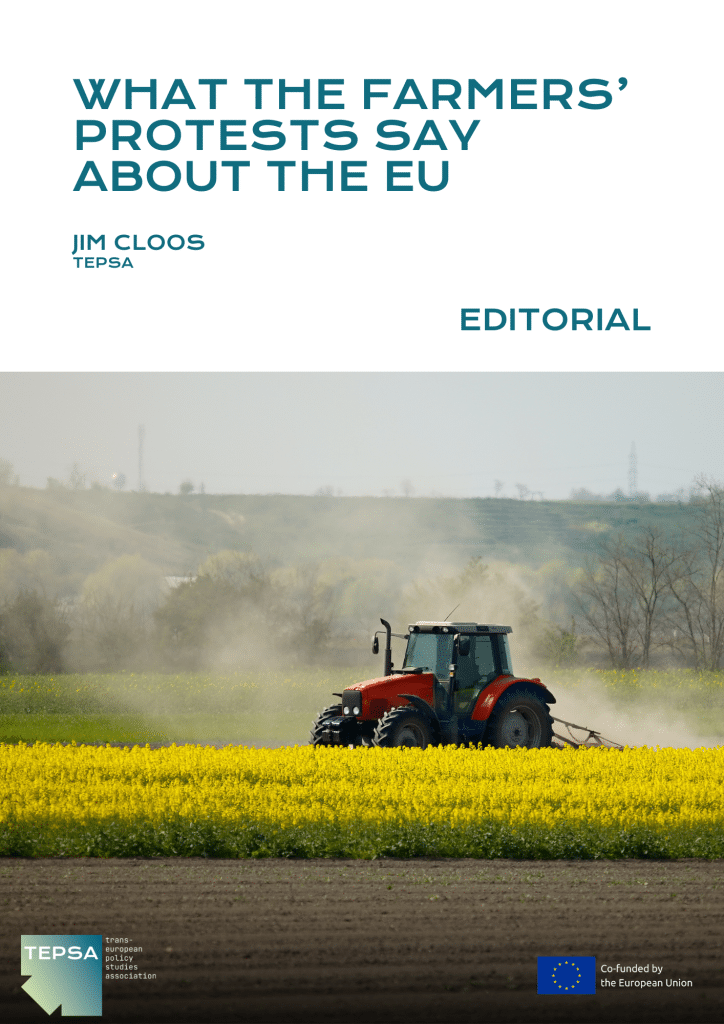
Over the last weeks we have seen mass demonstrations and blockades from farmers. They complain about low prices, unfair competition, and overregulation. Protests in Poland against Ukrainian exports add a geopolitical flavour to an already complicated equation. In the noise and din surrounding these developments it is difficult to distinguish fact from fiction, but that is precisely what we need now.
Let us first look at overregulation and the administrative burden. This is an issue going beyond agriculture; observers have unfavourably compared the more punitive approach of the European Green Deal with the incentive-based one of the Inflation Reduction Act in the United States. Anyone familiar with European Union financing knows that it often involves micromanagement, requests for constant reporting and multiple controls. The ‘zero-risk approach’ sounds great in theory; in practice, distrust as the default position leads to excessive control and interference, with an emphasis on box-ticking and procedure. That is why there is often talk in Brussels about simplification packages; alas, they rarely lead to significant improvements on the ground. Concerning agriculture, the progressive move over the years from guaranteed prices towards an income-related scheme with payments for greening is more difficult to administer and, indeed, requires more controls. But there must be a better balance between rooting out fraud by severely punishing the fraudsters and imposing additional requirements on the vast majority of people who do not fraud. Member States compound the problem by practicing what insiders call ‘gold-plating’: when they transpose EU legislation, they go well over the required minimum rules and add their own bureaucratic devices and rules. This does not prevent them from blaming ‘Brussels’ when things go wrong.
As a result of the recent demonstrations, the Commission and the Council have had a fresh look at the ‘good agricultural and environmental conditions’(GAECs) that farmers must respect to benefit from subsidies in the framework of the Farm to Fork programme. The idea is to render some of them voluntary and to compensate farmers who implement them financially. This concerns, for instance, the requirement to grow cover crops between seasons to conserve soil, water and nutrients, or the need to set aside at least four percent of farmland for biodiversity, or obligatory rotation of crops. Other initiatives address the concerns of small and medium farmers, like exempting farmers with less than 10 hectares of land from controls and penalties, or strengthening their position vis-à-vis traders, retailers, and other actors in the supply chain. This is legitimate, not least because the support per ha paid by the EU to farmers privileges the bigger farms.
Critics immediately accused the EU of weakening its commitment to fight climate change. It is important to dispel that impression and to reconfirm the target of reaching a carbon-free environment in 2050. What we are talking about here is looking for better ways to get farmers and citizens on board; it is not about abandoning the objective. Of course, it would be better to think about the practical difficulties of measures beforehand rather than giving in to protests afterwards, thus conveying the impression that you must wheel out tractors and block roads to get a hearing. The farming community must of course do its bit; theirs is already and will be more so in the future one of the sectors hardest hit by climate change.
The second major complaint by farmers is about the alleged negative effect of free trade agreements. Here, we enter the realm of fiction, disinformation, and fake news, with potentially quite dramatic results for Europe’s prosperity. The risk is that the EU will deprive itself of one of its strongest economic assets, thus putting paid to its ambition to be a strong global player.
The EUhas concluded 47 preferential trade agreements with over 79 countries across the world, for a good reason; trade is a factor of prosperity, it helps improve productivity via healthy competition, it allows Europe to buy the goods and resources it needs for its own development, and it creates space for European exports. Agriculture is not sacrificed on the altar of free trade because special rules apply to it. And the European trade balance for agriculture and food is massively positive, increasing from 10 to 70 billion euros a year over the past fifteen years.
Let us look at the EU-Canada Comprehensive Economic and Trade Agreement (CETA) first. The provisional application of this agreement since 2016 has benefited trade, including in the food and agricultural sectors. French exports in this sector have increased by 68%, for example. It is odd and characteristic of our times that in the public debate the voices of those who benefit from CETA remain silent or are not heard. The feared import surge of Canadian beef to the EU has not materialised at all. The reason for this is that the EU does not accept beef with hormonal growth promoters. The EU does not import products that do not respect its sanitary and phytosanitary rules; it is an absolute red line. Endlessly repeating the opposite does not lend it more truth. The situation is different as concerns standards for the environment, workers’ rights, or human rights. Here the EU tries to spread its reading of things through so-called ‘mirror clauses’ in the trade agreements. This is also the case for the projected Mercosur agreement, something which President Macron seems to have forgotten, judging from some of his statements during his state visit to Brazil. But the EU cannot impose via trade agreements all its rules in a sort of extra-territorial imperialism. Europeans hate it when the US does that but seem to assume that it is fine when we behave in the same manner. It is true that farmers in third countries do not have the same constraints as European ones in these areas. But that is precisely why the EU spends about EUR 40 billion every year to compensate the farmers for greening measures imposed on them.
The biggest red flag to farmers seems to be the MERCOSUR agreement. But we are here talking about projected negative effects; no such agreement exists for the time being. How can it be responsible for the present woes of the European farmers? Concluding it is in the EU’s core interest. Our trade with other Latin American countries (with whom we do have trade agreements) has increased over the past years, while our part in MERCOSUR imports has decreased from 35% to 18%, and the Chinese are having a field day. It is true that countries like Argentina, Brazil and Uruguay are big and competitive producers of sensitive agricultural goods like beef, sugar, and others. But no one talks of opening the flood gates to such products to Europe. We are talking about customs-free tariff contingents amounting to less than 1% of EU consumption. The effect on prices and production would be real but perfectly manageable. It is possible if necessary to compensate it at a very affordable cost to the EU budget. The overall benefits for the EU economy, standing and own exports would be incommensurable compared to the costs. Using Trump-like false assertions is a bad idea and will cost the EU dearly if not checked.
Finally, a word on the debate about Ukrainian agricultural exports and the effect on our markets. To help Ukraine export its agricultural products by routes other than the Black Sea following the Russian aggression, the EU suspended customs duties in May 2022 also for agricultural products. This was an understandable decision but probably a rash one. Exports via (and to) the EU soared, increasing from eight million tons in 2022 to 18 million in 2023 for cereals, and from 20,000 tons to 400,000 tons for sugar for instance. Local traders in Poland and elsewhere in the EU used the opportunity to buy a part of the Ukrainian exports at low prices. Coming on top of the massive Russian exports of cereals at competitive prices, including (at low or no tariffs!) to the EU (from about 960,000 tons in 2022 to 1.5 million tons in 2023), this has led to a plunge in prices within the EU and created severe difficulties in a country like Poland. They need addressing. Prime Minister Tusk put it thus in a long interview with a group of European Newspapers (LENA or Leading European Newspaper Alliance) published on 29 March: “Noone does more than Poland when it comes to helping Ukraine… The saddest moments of my political career are those when I must be tough and rude with our Ukrainian friends. I am probably the most pro-Ukrainian politician in Europe, but I am responsible for my fellow citizens… I am there to defend the fundamental interests of Poland… the interests of millions of Polish citizens are threatened by trade liberalization between the EU and Ukraine.”
In these circumstances the EU authorities are now discussing two parallel measures. The first one is to impose a tariff of EUR 95 per ton of grain on Russian cereals, which currently sells for up to EUR 220. This is both an economic necessity and a moral imperative. Solidarity with Ukraine remains an overriding political must; therefore, the temporary suspension of all outstanding (not liberalized) customs duties and quotas under Title IV of the Association Agreement between the EU and Ukraine will continue for another year. But the EU will simultaneously reinforce the protection of sensitive agricultural products by strengthening safeguards already included in the current regulation on temporary trade-liberalisation and adding new automatic safeguards for specific products such as poultry, eggs, and sugar. Those safeguards allow to intervene in case of massive surges in imports destabilising local markets.
As we enter a period of key elections both at the EU and the national levels, there is a crying need for honest, clear, and fact-based communication. We should not allow the extremists and euro-sceptics to occupy all the ground and to instrumentalise the farmers’ protests. That means both addressing legitimate concerns of the latter and debunking false and misleading propaganda against the EU, the Common Agricultural Policy, and the necessary fight against climate change.