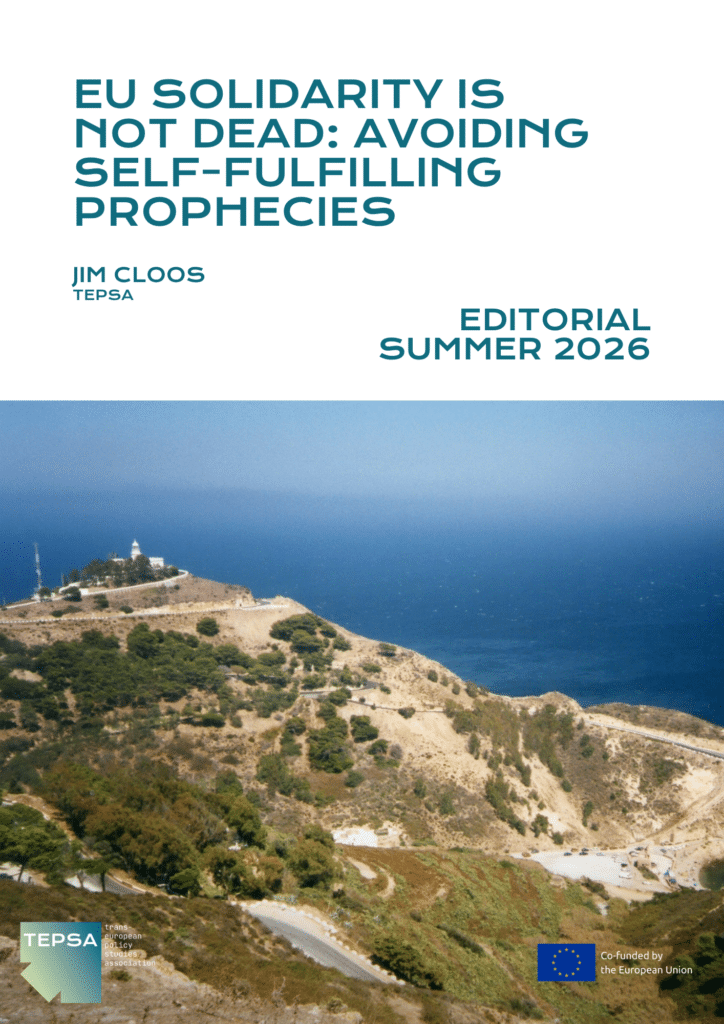
Following the sudden arrival of tens of thousands of migrants from Morocco in Ceuta, Daniel Carretta published a commentary ‘EU solidarity died in Ceuta’. The title reminds me of a quote by Mark Twain, “Rumours of my demise have been greatly exaggerated.” Sweeping statements of this kind are understandable in the heat of the argument, but can, if unchecked, turn into a self-fulfilling prophecy. There is no general breakdown of solidarity; just think of the mutual assistance provided by European countries to each other in the fight against the forest fires raging across the continent.
However, the initial reactions in the European Union (EU) to Ceuta revealed deep tensions among the Member States and raised serious questions about EU solidarity. Carretta was right in lambasting the political game-playing that transformed a crisis originating outside the EU into an EU crisis. When confronted with migration pressures, some governments still instinctively see another Member State’s difficulty as “its problem” rather than a challenge to the Union as a whole. In this case, short-term political considerations trumped the long-term interests of the EU and allowed outside actors to divide the Europeans. In a public letter proposed by Italy and Denmark, 22 European Heads of State or government implied that the influx of migrants into Ceuta was a direct consequence of the recent decision by Madrid to legalise the presence in Spain of more than a million migrants. This was more about winning an argument in the long-running debate about migration than about solving the immediate crisis.
It is important to set the context. The drama of Ceuta has reignited the discussion on migration simmering within the EU since 2015. We still remember the emotion caused when Angela Merkel said “Wir schaffen das” during the Syrian refugees’ crisis. The issue revolved around relocating asylum seekers and distributing responsibilities among Member States. At the time, other leaders feared that this message would act as a pull factor, encouraging more people to enter the EU illegally. The EU eventually strengthened cooperation on the external borders, found an arrangement with Turkey, and launched a major debate about migration.
Ceuta raised the question of the Union’s reaction when one Member State faces externally induced pressure on its external border. It opened old wounds. It is important to lower the temperature and recall a few basic facts concerning this crisis.
The sudden influx of 72 000 people into the enclave took everybody by surprise. One need not be a proponent of conspiracy theories to imagine that this was not a ‘natural’ event. According to Thierry Breton, it was the first major hybrid attack on the EU’s external borders. It is also possible that the Moroccan authorities played a part in the events, for political reasons. A less spectacular episode happened in 2021 after Spain hosted Brahim Ghali, the leader of the Polisario Front opposing Moroccan occupation of Western Sahara, for medical treatments. This time, Prime Minister Pedro Sánchez’s visit to Algeria on 20 July that 2026 may have angered Rabat. It appears that in Fnideq, bordering Ceuta, the usual checkpoints preventing people without European documents from approaching the frontier had been removed. It is important for the EU to carry out a serious analysis of what exactly was behind this crisis and draw conclusions from it. This is primarily a matter of European security, as was the case with the behaviour of the Belarus authorities at the border with Poland.
But in the Ceuta case, the reaction of 22 Member States was impetuous and unfortunate. Only France, Portugal. Luxembourg and the Irish Presidency refused to sign the letter expressing concern. They considered that the priority was helping Spain manage the situation created by the weaponisation of migrants. European Council President António Costa took the same position. The possible effect of a massive legalisation of irregular migrants in one Member State on the EU’s migration policy and Schengen deserves an open exchange among the 27, even if it is a matter of national competence. But the timing and manner of addressing it were problematic. By establishing a direct link between the Spanish regularisation and Ceuta, the Italian and Danish Prime Ministers who were spearheading the initiative were in fact settling scores after the heated debate they had with Sánchez on regularisation at the June European Council.
It is most unfortunate that the rhetoric used by some political circles in the days after the event seemed to echo ideologically inspired attacks against the EU and its migration policy by outside forces and the extreme right within the EU. Anne Applebaum, in an article in The Atlantic, refers to patently false claims about the Ceuta crisis spread by Vice-President J.D. Vance and figures like Nigel Farage and Alice Weidel.
The Spanish government reacted quickly and efficiently. It restored control through reinforced policing, cooperation with Morocco once relations normalised, and rapid returns under existing bilateral arrangements. The acute crisis subsided within days. That deserves recognition because it demonstrates that competent national action, ideally combined with European political backing, can prevent local crises from becoming continental ones. Had all the other Member States and the institutions communicated on full solidarity with Spain from the start, the EU would have emerged with enhanced credit from the whole affair. Instead, some people will conclude that sometimes it is better to act nationally without the intervention of the EU.
The initial positioning of Commission President Ursula von der Leyen, rightly or wrongly, led commentators to conclude that she followed party political lines and echoed the “new political majority” (the European People’s Party and extreme right) on migration within the European Parliament. The idea of a “political” Commission in the sense of a party-politically aligned one that has been pushed over the last years in the context of the debate about the Spitzenkandidaten encourages this kind of suspicion. It tends to overshadow the Commission’s traditional role as defender of the common interest of countries, parties and citizens. Ursula von der Leyen quickly rectified the course, and in her letter to Sánchez on 3 August she praised Spain for its handling of the crisis and called for a united European response. She said that the episode showed the need for stronger controls at the EU’s external borders, closer cooperation with partner countries, better early-warning systems, action against smuggling networks and more effective returns. This is certainly a line Sánchez will accept.
Concerning Schengen, it bears pointing out that there is no free movement for migrants between Ceuta and the rest of the EU, and that there have been no illegal entries into the Schengen area from the enclave. The Spanish authorities have managed to send back most migrants. Therefore, any calls for suspending Spain from Schengen are not calls to “save” Schengen, but part of an old campaign by the extreme right to kill it. Such a move would anyway be legally impossible; it is sad that a former President of the European Parliament, Italian Foreign Minister Antonio Tajani, called for such a move which would have rewarded the strategy of those seeking to divide the Union. Schengen is a major achievement of the EU and should not be lightly endangered. It foresees safeguard clauses and the possibility of reimposing temporary border control in a situation of crisis. But there was not the slightest justification for doing so in this case.
I conclude with a general remark and a wish. The remark is that the EU is more resilient than many people believe. It often struggles when a crisis erupts but it usually finds a way to deal with it. The last 20 odd years have repeatedly produced predictions of existential collapse. Each crisis exposed weaknesses and disagreements, yet each also generated new forms of cooperation. I hope that Ceuta belongs in that same category. There are some signs of that. The emotional rhetoric of the first days has given way to a more constructive atmosphere. At a special online meeting on 4 August, the European Ministers in charge of migration pledged solidarity with Madrid and focussed on the lessons to draw from what happened.
But we cannot be complacent. The Ceuta incident revealed a very charged political environment with strong temptations to instrumentalise a crisis for political purposes, including with a view to looming national elections. Some of the critical voices heard over the last days go well beyond the issue of migration and translate frustration with Spain’s particular stance on NATO and relations with the United States as well as on the Israel-Palestine conflict. That is a worrisome development at a time when outside forces try to divide the EU and when social media amplify reactions, spread disinformation, and whip up emotions. The strength of the EU has been precisely to keep up dialogue, whatever the disagreements, and to work on solutions rather than point-scoring and political games.
The wish is that we in the EU preserve this asset. That we avoid opening the door to the forces in and outside Europe who hate the EU for what it is and try to undermine it. That we adopt by default a posture of solidarity (“solidarity reflex”) vis-à-vis crises originating from outside the EU, be they about migration, about Greenland, or about predatory economic policies. That we discuss disagreements internally rather than via social media and selective open letters. That we avoid scoring short term national gains, be they ideological, political or economic, at the expense of EU partners and to the detriment of the common interest. And finally, that we refrain from sweeping statements that risk becoming a self-fulfilling prophecy.